
Let’s begin by saying that neuroplasticity is the brain’s ability to reorganize itself throughout life. As you remember in my previous article, Cognition. Oh, could you repeat that, please? https://medium.com/@saccharo, I argued that our ability to process and respond to our circumstances diminishes with time. Consequently, the capability of our brain to rearrange throughout life is affected. The cause of shrinking cognition brings about the effect of the arrest of positive neuroplasticity.
There are 100 million neurons (nerve cells) in our brains. These neurons (chemical synapses) talk to each other through electrochemical reactions. Chemical synapses never touch. It is a chain reaction. The cause of specific electrochemical changes in one neuron produces the same changes in another, and so on. Let us see how one of the geniuses of 500 years ago intuited this process and its consequences.
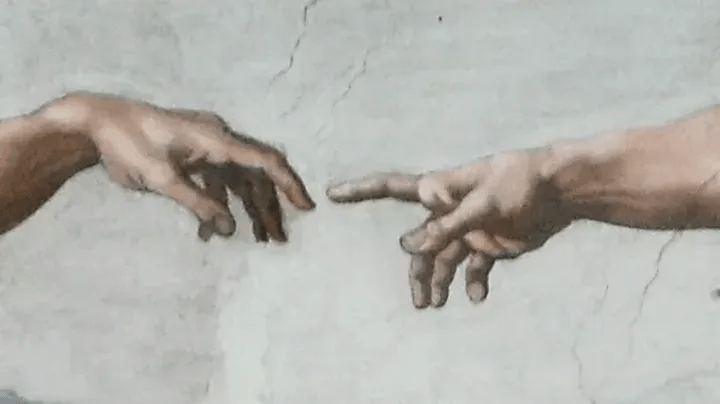
Michelangelo di Lodovico Buonarroti was the most famous artist of his time. A superstar of the High Renaissance period. He told his assistants, “A man paints with his brain and not his hands.” Today most everybody will understand that assertion, but more than 500 years ago, that affirmation would have sounded at least odd. Michelangelo painted with his hands, but he knew the role his brain played. To grasp the depth of his intuition, please look at the picture above. This famous image is from The Creation of Adam in the ceiling of the Sistine Chapel at the Vatican. Observe how the index finger of God points at Adam’s index finger but does not touch it. And by doing so, he gives him life. Michelangelo portrayed in this fresco the conception of life from God to man in the same way neurons pass information to other neurons. For many, this declaration might be a mere flight of fancy. Or could it be an intuition of the genius of how the brain works? Another relation of cause and effect?
Dr. Alvaro Pascual-Leone, Professor of Neurology at Harvard Medical School, tells us that; “The world changes very fast, too fast for the genes to be able to modify our brain and make us able to cope with these changes. So, nature invented plasticity, the brain’s capacity to be modified to cope with the changes in the world…Plasticity changes the nature of synapses (connections between neurons) and the number of synapses in the brain. These changes can occur following any activity of the brain.” [1]
It is estimated that our species has been around for about 200,000 years. In the beginning, the world of information moved very slowly, but today is impossible to cope with. We either deal with it or perish. Fortunately, our brain has the property of neuroplasticity. Next time we will talk about how to take advantage of it properly.
Note: If you want to dig deeper into these concepts, I recommend reading Soft-Wired by Dr. Michael Merzenich and The Sharp Brain Guide to Brain Fitness by Alvaro Fernandez, Dr. Elkhonon Goldberg, and Dr. Pascale Michelon.
[1] The SharpBrains Guide to Brain Fitness. 2013. Fernandez, Goldberg, and Michelon p. 60.
File: The Creation Michelangelo Italy Vatican-Creative commons by gnuckx (3492637506).jpg From Wikimedia Commons, the free media repository

 The Longevity Gazette