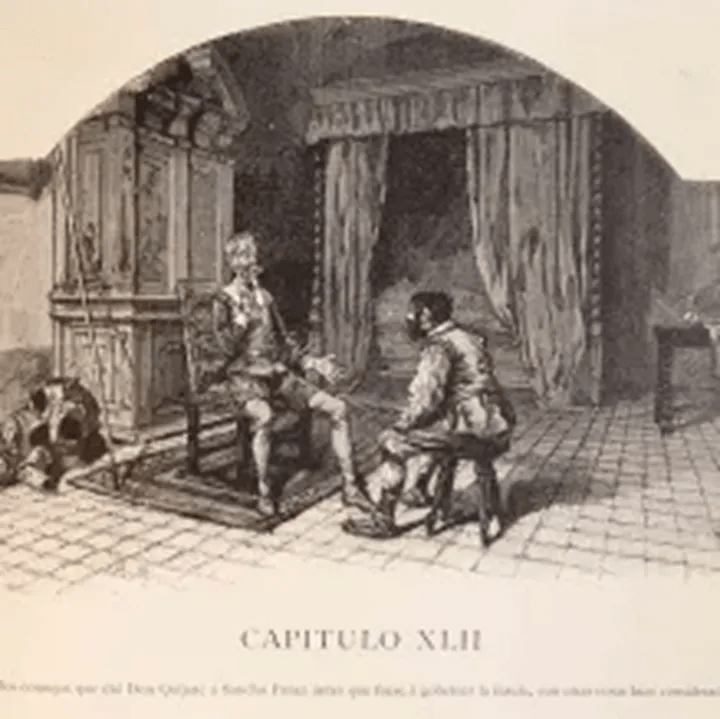
“What flask and what Potion are this,” said Sancho Panza. It is a balm, replied Don Quixote, of whom I have the recipe in my memory, with which there is no fear of illness, nor can I fear death.” (^)
Humans have been searching for the remedy for all our ills for centuries. Observe the quote from the famous and immortal story of the Ingenious Hidalgo Don Quixote de la Mancha, written in 1647. When reading the story, we laugh at the follies of Don Quixote and the naivety of Sancho. However, we are already in the first quarter of the Twenty-first Century, almost four hundred years after Cervantes wrote Don Quixote. We are still looking for the Potion of Fierabrás, the magic pill to cure everything. We will not say that we will not find it, but I think we can recommend that you do not wait for it standing up because you will get tired. Now, the potion of Fierabrás is one more chimera. However, we have other tools to improve our cognitive functions.
One of them is learning to discern. Webster’s New Dictionary [1] defines the term as to perceive as separate as distinct. Look, perceiving is like putting together a puzzle. We must pick the right pieces and put them together. However, the task will be easy if they have a photo or an engraving of what we want to put together. Even more, the task becomes a challenge when discussing the human brain. Stay calm about this. There is help.
In this article, we will only discuss one topic masterfully expressed in the book “The SharpBrains Guide to Brain Fitness “by Alvaro Fernandez, Elkhonon Goldberg, and Pascale Michelon. Cognitive biases.
Our minds have unique characteristics that influence our decision-making, called cognitive biases. Our intellect has individual factors that influence our decision-making, called cognitive biases. Cognitive biases are the inclination to make decisions based on the peculiarities of our minds. Cognitive biases can be defined as the inclination to make decisions based on the peculiarities of our minds.
Sure enough, our brain is peculiar. Without the slightest doubt, it is the most developed of all species. It weighs about 7 pounds, which is only 2% of body weight, but consumes 20% of the energy of the rest of the body. He can forge languages, read, write, create art, invent science, compose music, perform, think the unthinkable, ponder philosophy, remember the past, document history, feel emotions, etc. However, it is an imperfect organ in development trying to adapt to an environment that changes at a speed that makes it dizzy. Within the range of its limitations is that of cognitive biases. We will talk about two of them:
Exposure effect: “This is the tendency for us to like things simply because they are familiar. For example, since we have heard for decades that puzzles or blueberries are crucial for promoting brain health, we convince ourselves that they are. Perhaps this can be explained by the fact that processing familiar things requires less effort.” [2]
Closeness bias: “This is the tendency to overvalue and remember the most recent information more vividly. For example, reading the latest news story today may lead you to give it more credit than another one you read last week, even though it is of poorer quality. Imagine the continued impact of this bias given the barrage of daily news.” [4]
Humans are always in a self-dialogue; other human beings and entities constantly visit us through computer networks such as phones, computers, and tablets. But for there to be dialogue, both parties need to manage their ideas and both parties to suspend passing judgment or judging for the duration of the exchange of ideas or information. The reader has undoubtedly already understood that we cannot discern if we do not consider our cognitive biases. However, if we are unaware of our cognitive biases, we fall into the error of believing only we are right. That’s why we started this dialogue talking about discernment.
The following article will discuss one of the most important tools to change our brains to adapt to new realities. I am talking about computerized brain training programs — specifically BrainHQ.
Until the following article. All the best to you and your family. Thank you.
(*) Fierabras (from French: fier à bras, “brave/formidable arm”) or Ferumbras is a fictional Saracen knight (sometimes of gigantic stature) appearing in several chansons de geste and other material relating to the Matter of France.
(^) Part Two Chapter X. First and Second Part of the Ingenious Hidalgo Don Quixote de Mancha Composed by Miguel de Cervantes Saavedra. National Academy of the History of Venezuela. Facsimile edition of the original of the year 1647. Talleres de Italográfica S.A. 1992 Caracas, Venezuela.
[1] Webster’s New Riverside Dictionary. Berkley Books New York
(2) The SharpBrains Guide to Brain Fitness “by Alvaro Fernandez, Elkhonon Goldberg, and Pascale Michelon.
[3] The SharpBrains Guide to Brain Fitness “by Alvaro Fernandez, Elkhonon Goldberg, and Pascale Michelon. 2013 SharpBrains Inc.
[4] The SharpBrains Guide to Brain Fitness “by Alvaro Fernandez, Elkhonon Goldberg, and Pascale Michelon. 2013 SharpBrains Inc.

 The Longevity Gazette